DLSU Mathematics and Statistics Seminar
Organizers: F. Co, N. Fortun, A. Lao, and D. Granario
The DLSU Mathematics and Statistics Seminar is an online lecture series launched in Term 3 of AY 2023–2024, featuring three to four sessions each term. The seminar aims to introduce undergraduate students to a broad range of topics in mathematics, statistics, and related disciplines, including expository talks. Speakers range from established researchers to promising undergraduate students, and invitations are extended with a commitment to diversity in research areas, institutional affiliations, gender, and background.
Seminar Archive:
Upcoming Lectures
Series 8 (Term 1 AY 2026-2027)
TBA: Dr. Robert Martin Santiago (TBA)
TBA: Dr. Jryl Maralit (algebraic combinatorics)
TBA: Dr. Raiza Corpuz (Iwasawa theory)
Series 7, Lecture 4
An Introduction to Marshall-Olkin Method in adding a parameter to a family of distributions
Dr. Isagani Jos
Department of Mathematics and Statistics, De La Salle University, PH
A method to create new distributions from known distributions by adding a parameter proposed by Albert W. Marshall and Ingram Olkin in 1997. This method has been applied to many known distributions and has been applied to several types of data, including insurance-related data. In this talk, we will discuss the application of the said method to some families of distributions, which include but are not limited to the exponential, Weibull, loglogistic, power lognormal, Pareto.

Series 7, Lecture 3
$\theta_\beta$-Open Sets and $\theta_\beta$-Continuous Functions in the Product Space
Ms. Laika Angela B. Añora
Department of Mathematics and Statistics, Mindanao State University–Iligan Institute of Technology, PH
Numerous mathematicians have been drawn to the idea of refining or expanding classical concepts in topology by replacing them with alternatives that possess either weaker or stronger properties. Notable examples include $\theta$-open sets and $\beta$-open sets, introduced by Velicko and El-Monsef et al., respectively. Motivated by these developments, we introduce and characterize a new class of open sets called $\theta_\beta$-open sets. We prove that the collection of all $\theta_\beta$-open sets forms a topology and examine the relationship between $\theta_\beta$-open sets and other well-known concepts, such as classical open sets, $\theta$-open sets, and $\beta$-open sets. Furthermore, we define and investigate the concepts of $\theta_\beta$-interior and $\theta_\beta$-closure of a set, along with $\theta_\beta$-open functions, $\theta_\beta$-closed functions, and $\theta_\beta$-continuous functions, and $\theta_\beta$-continuous functions in the product space.
Series 7, Lecture 2
Extreme Value Modeling with Applications in Finance
Dr. Peter Julian Cayton
School of Statistics, University of the Philippines Diliman, PH
The talk explores the application of Extreme Value Theory (EVT) within quantitative financial risk management, specifically addressing the inadequacies of traditional normal distribution models in capturing extreme market events. Asset returns frequently exhibit volatility clustering, heavy tails, and negative skewness; these characteristics are stylized facts of financial time series data that standard Gaussian models fail to approximate effectively. Consequently, these deviations necessitate robust quantitative risk measures, such as Value-at-Risk (VaR) and Expected Shortfall (ES), to better estimate capital buffers required by regulators like the Bangko Sentral ng Pilipinas.
There are two fundamental theorems of EVT that describe the asymptotic behavior of extreme values. First, the Fisher-Tippett-Gnedenko theorem demonstrates that the distribution of block maxima converges to the Generalized Extreme Value (GEV) distribution, which encompasses Fr´echet, Gumbel, and Weibull families depending on the tail behavior of the underlying data. Second, the Pickands-Balkema-de Haan theorem establishes that conditional excesses over a high threshold converge to the Generalized Pareto Distribution (GPD).
Building on these theorems, there are two primary modeling approaches: the Block Maxima approach, which fits the GEV distribution to maxima selected from non-overlapping periods, and the Peaks-over-Thresholds (POT) approach, which fits the GPD to data exceeding a specified threshold. A demonstration of an analytics workflow that combines these methods with time series modeling is shown. This involves fitting an ARMA-GARCH model to capture volatility clustering and subsequently applying the POT method to the negative standardized residuals to estimate tail risk.
Series 7, Lecture 1
Embedding matrix algebras into ultragraph Leavitt path algebras and applications
Dr. Romar Dinoy
College of Teacher Education, Bohol Island State University-Clarin Campus, PH
We provide a criterion for an ultragraph $\mathcal{G}$ so that for any field $K$ and $n \geq 1$, the matrix algebra $M_n(K)$ is embedded in the associated Leavitt path algebra of $\mathcal{G}$. This result, which has not appeared in the context of Leavitt path algebras of graphs, is then applied to prove properties of Lie solvable and Lie nilpotent ultragraph Leavitt path algebras.
Series 6, Lecture 2
Multi- and Mixed-Precision Computations for Spatial and Spatio-Temporal Statistics
Dr. Mary Lai Salvaña
Department of Statistics, University of Connecticut, USA
Computational statistics has traditionally utilized double-precision (64-bit) data structures and full-precision operations, resulting in higher-than-necessary accuracy for certain applications. Recently, there has been a growing interest in exploring low-precision options that could reduce computational complexity while still achieving the required level of accuracy. This trend has been amplified by new hardware such as NVIDIA's Tensor Cores in their V100, A100, and H100 GPUs, which are optimized for mixed-precision computations, Intel CPUs with Deep Learning (DL) boost, Google Tensor Processing Units (TPUs), Field Programmable Gate Arrays (FPGAs), ARM CPUs, and others. However, using lower precision may introduce numerical instabilities and accuracy issues. Nevertheless, some applications have shown robustness to low-precision computations, leading to new multi- and mixed-precision algorithms that balance accuracy and computational cost. To address this need, we introduce MPCR, a novel R package that supports three different precision types (16-, 32-, and 64-bit) and their combinations, along with its usage in commonly-used Frequentist/Bayesian statistical examples. The MPCR package is written in C++ and integrated into R through the Rcpp package, enabling highly optimized operations in various precisions. Moreover, we show how to leverage low precision computations for spatial and spatio-temporal statistics.
Series 6, Lecture 1
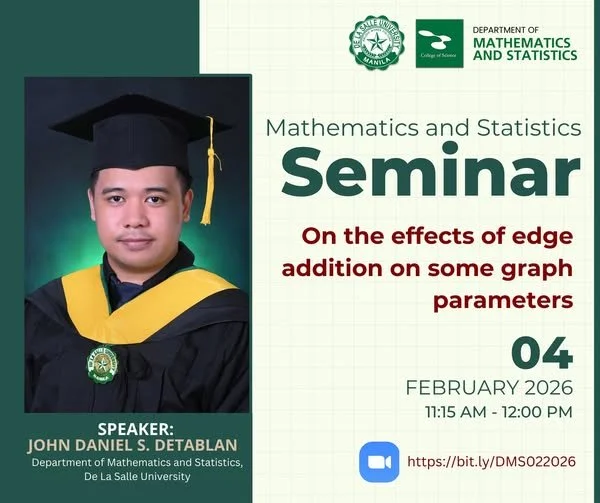
On the effects of edge addition on some graph parameters
John Daniel S. Detablan
Department of Mathematics and Statistics, De La Salle University, PH
In graph theory, graph parameters are numerical values that can used to describe graphs and compare similar or different graphs. Some of these graph parameters are the chromatic number and the independence number, denoted by $\chi(G)$ and $\alpha(G)$, respectively. The structures of graphs and their respective graph parameters may change through graph operations. Edge addition is a graph operation that joins two non-adjacent vertices with an additional edge.
In this talk, we will explore the maximum number of edge additions that can be performed on some graphs such that their chromatic number or independence number is preserved.