DLSU Mathematics and Statistics Seminar
Organizers: R. Arcilla, N. Fortun, and D. Granario
The DLSU Mathematics and Statistics Seminar is an online lecture series launched in Term 3 of AY 2023–2024, featuring three to four sessions each term. The seminar aims to introduce undergraduate students to a broad range of topics in mathematics, statistics, and related disciplines, including expository talks. Speakers range from established researchers to promising undergraduate students, and invitations are extended with a commitment to diversity in research areas, institutional affiliations, gender, and background.
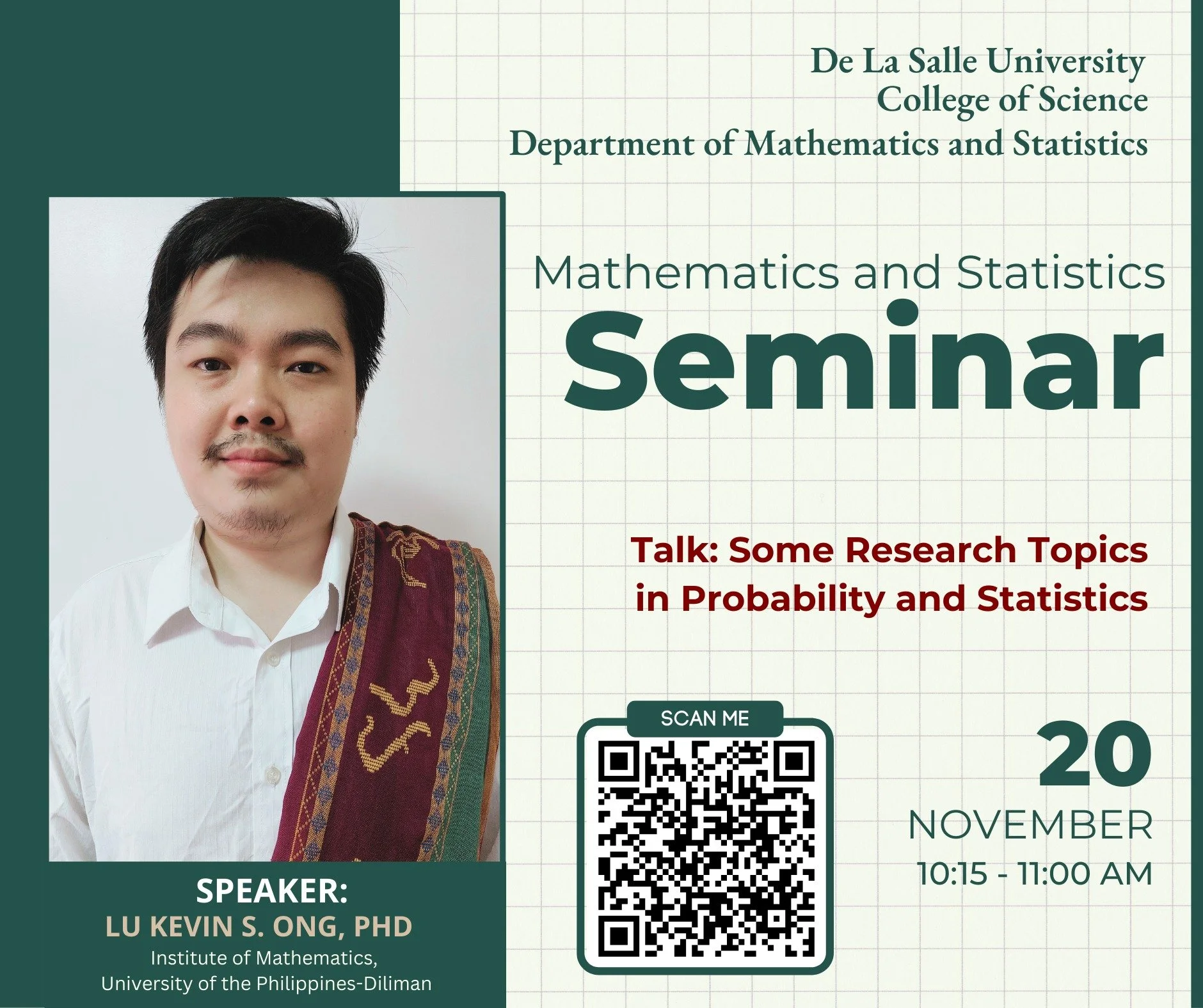
Series 2, Lecture 5
Some Research Topics in Probability and Statistics
Dr. Lu Kevin S. Ong
Institute of Mathematics, University of the Philippines-Diliman, PH
For this study, three different research topics in probability and statistics are discussed: ruin theory, copulas, and Markov chain convergence. Ruin theory is a branch of actuarial science that studies an insurer’s vulnerability to insolvency. Copulas are tools in statistics used to describe the dependence between random variables. In modern probability theory, the mixing time of a Markov chain is the time until the Markov chain is relatively close to its equilibrium distribution. Some results and applications of these topics are introduced.
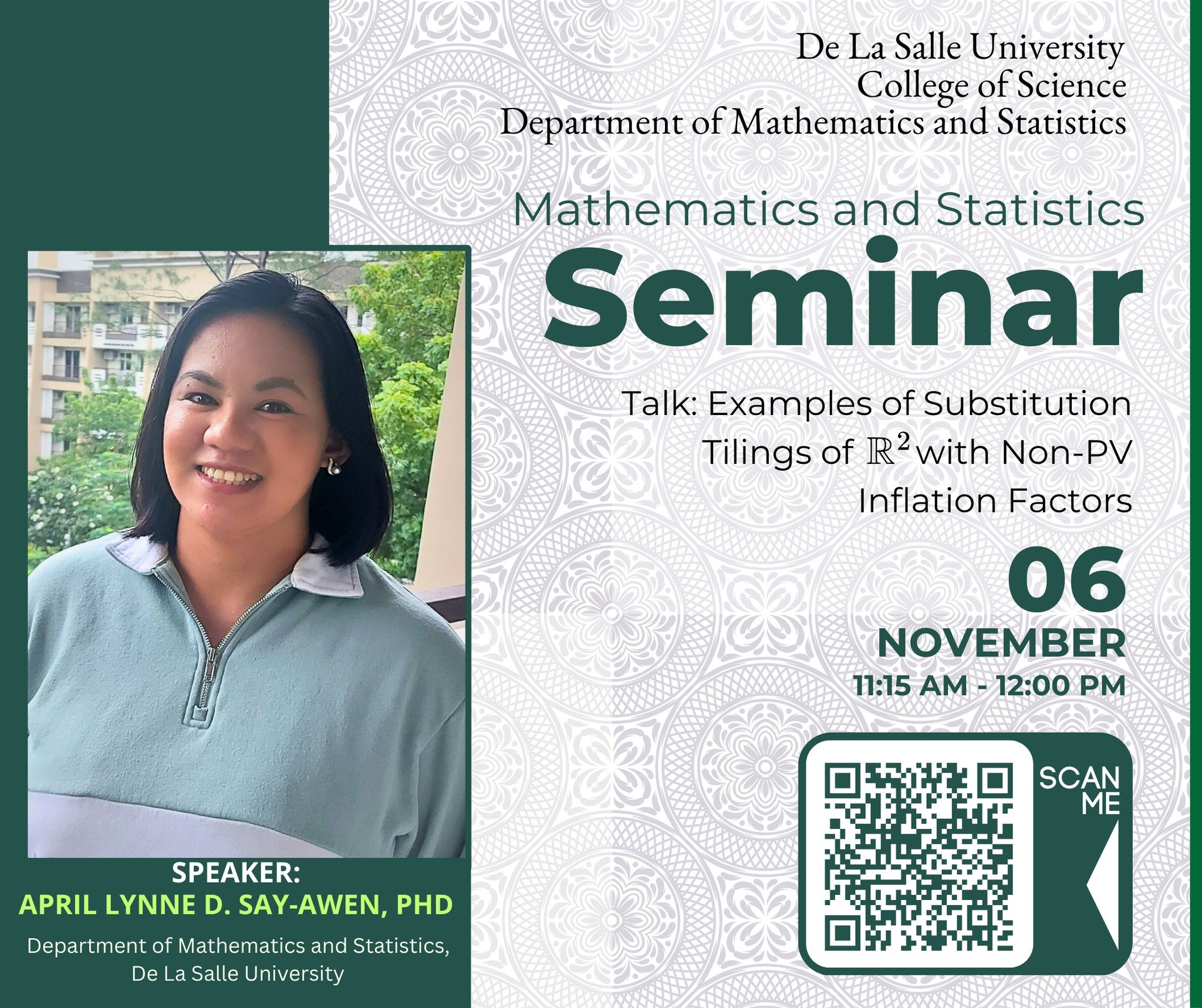
Series 2, Lecture 4
Examples of Substitution Tilings of $\mathbb{R}^2$ with Non-PV Inflation Factors
Dr. April Lynne Say-awen
Department of Mathematics and Statistics, De La Salle University, PH
A PV number is an algebraic integer $\eta$ such that $\eta>1$ and $|\eta'|<1$ for all algebraic conjugates $\eta'$ of $\eta$. Both PV and non-PV numbers play significant roles in the study of substitution tilings. In this talk, we will present examples of substitution tilings with non-PV inflation factors and demonstrate how the non-PV property can be used to prove that a tiling exhibits infinite local complexity.
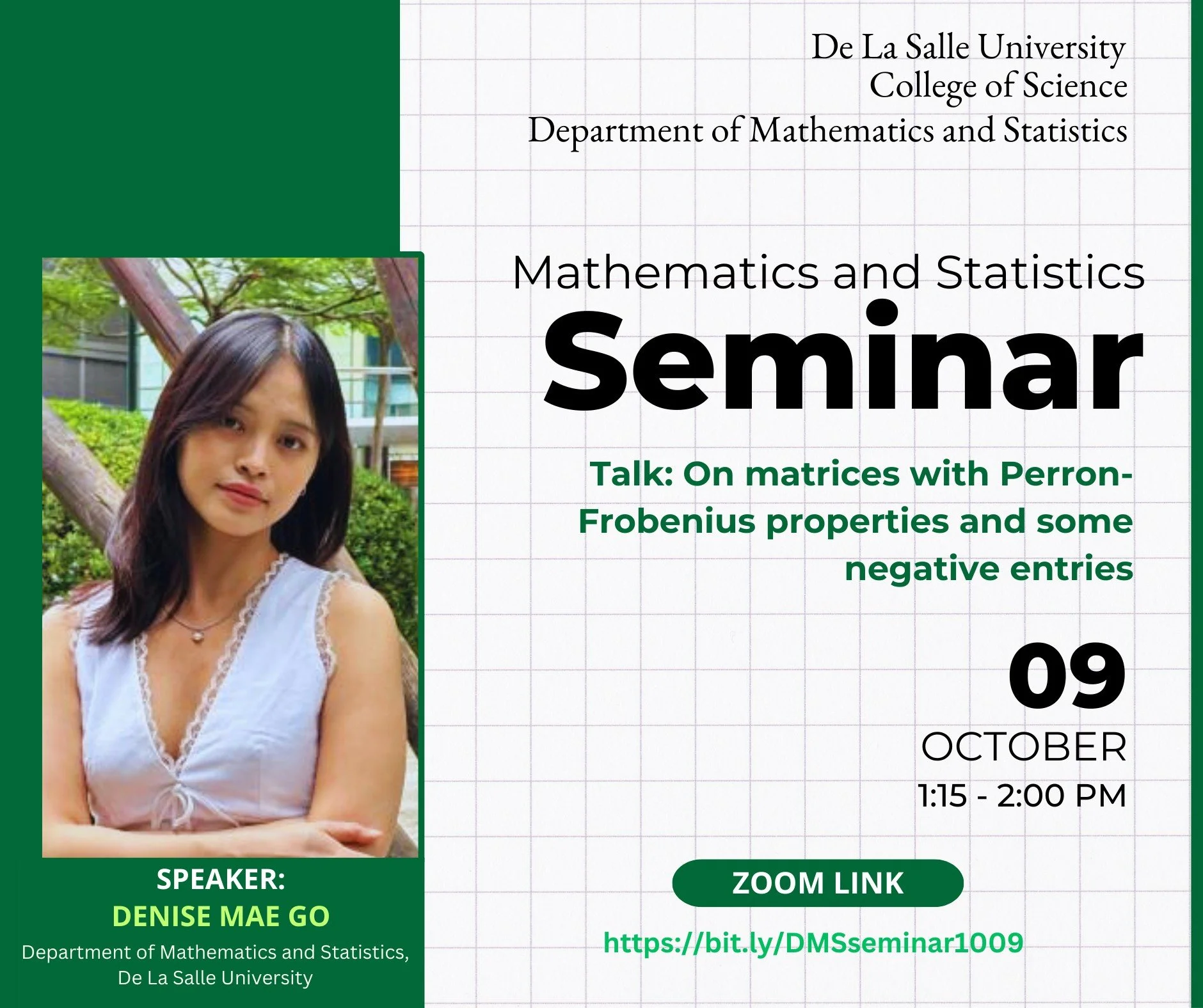
Series 2, Lecture 3
On matrices with Perron-Frobenius properties and some negative entries
Denise Go
Department of Mathematics and Statistics, De La Salle University, PH
The classical Perron-Frobenius theory was extended by Johnson and Tarazaga to matrices with some negative entries by studying matrices in a cone of center $ee^T$, where $e$ is the all-ones vector. In this talk, we look at the cone-theoretical approach to matrix analysis and present Johnson and Tarazaga’s construction of matrices exhibiting some Perron-Frobenius properties. Finally, we also discuss the limits in which matrices may have Perron-Frobenius properties.
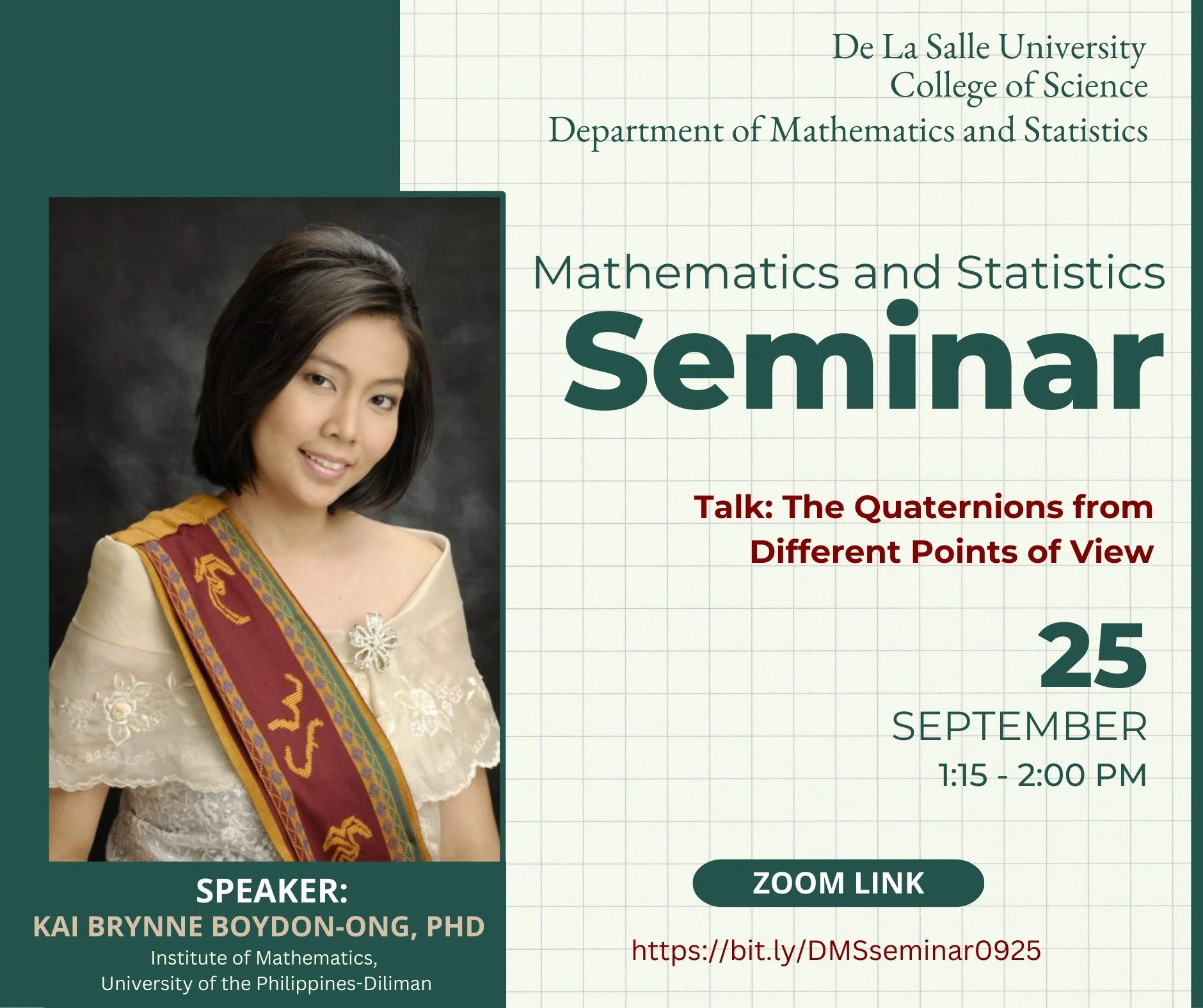
Series 2, Lecture 2
The Quaternions from Different Points of View
Dr. Kai Brynne Boydon-Ong
Institute of Mathematics, University of the Philippines-Diliman, PH
The Quaternions are known to be an extension of the complex numbers. They have abundant applications in computer graphics, mechanics, molecular dynamics, crystallographic texture analysis and many other fields of study. For this talk, we will study the quaternions as different mathematical objects: as a manifold, as a Lie group, and as a Clifford algebra. Lastly, we will look into a differential form that is invariant under quaternionic transformations.
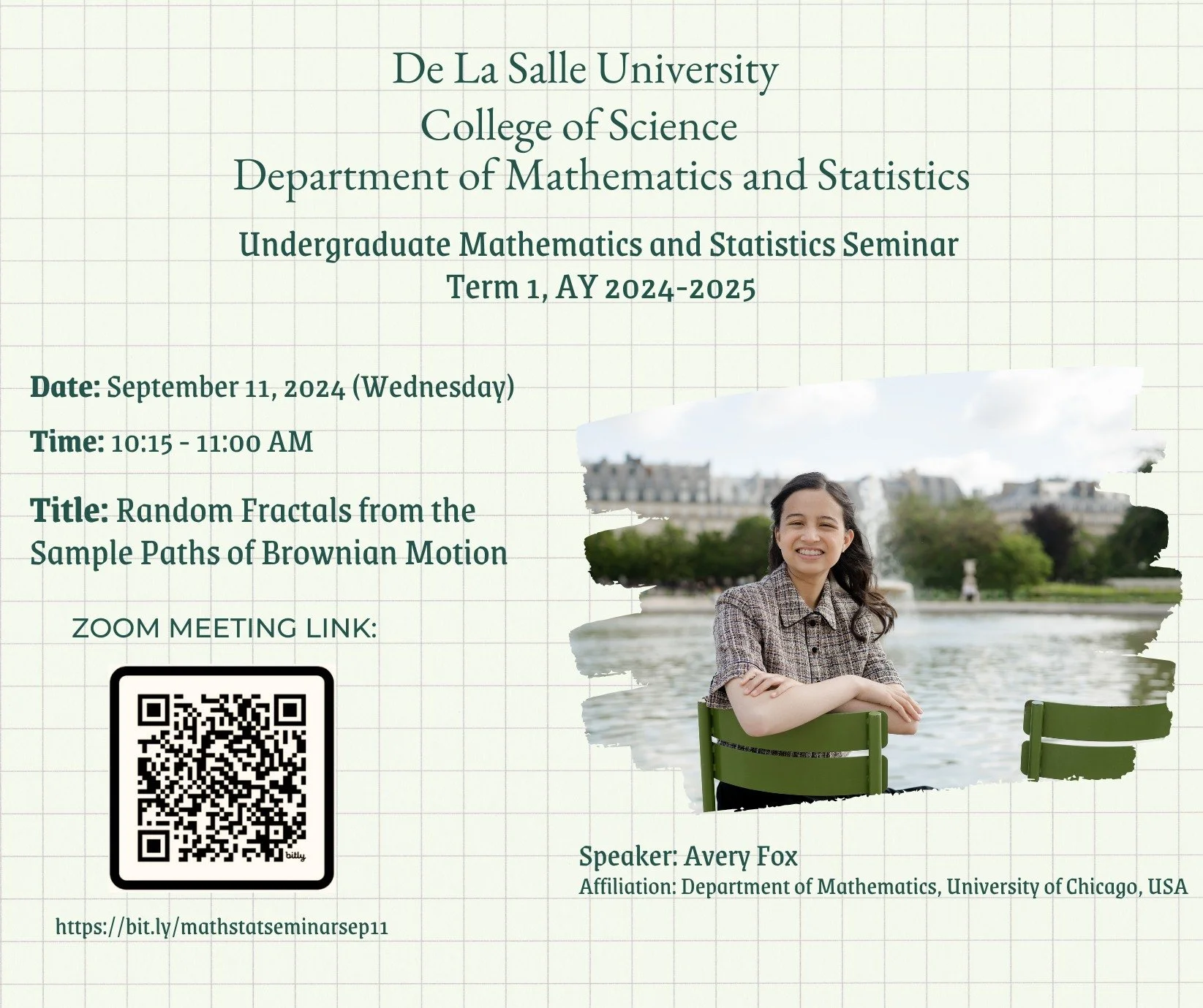
Series 2, Lecture 1
Random Fractals from the Sample Paths of Brownian Motion
Avery Fox
Department of Mathematics, University of Chicago, USA
In this talk, we will analyze some of the random fractals obtained from Brownian motion. In particular, we turn to the notion of Hausdorff dimension to provide us with almost sure dimensions of these sets. Time permitting, we will explore a family of sets derived from planar Brownian motion known as alpha-cone points, or points when a planar Brownian motion stays within a cone with angle alpha with a vertex along its path.
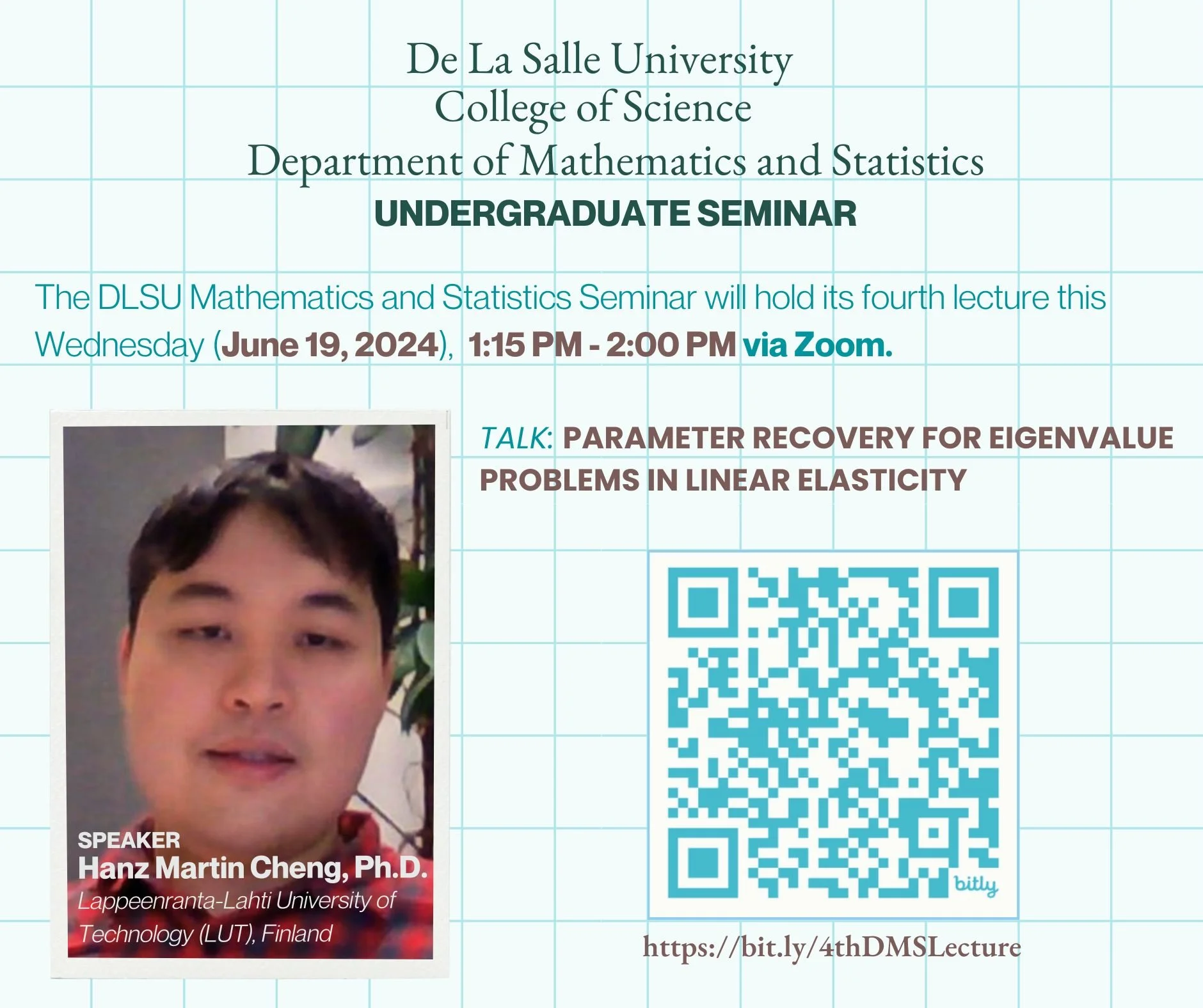
Series 1, Lecture 4
Parameter recovery for eigenvalue problems in linear elasticity
Dr. Hanz Martin Cheng
School of Engineering Sciences, LUT University, FIN
In this work, we discuss some classical numerical algorithms, and compare them with Ensemble Kalman Inversion (EKI) for recovering material parameters arising from eigenvalue problems in linear elasticity. This type of parameter recovery problem arises in the process of modal testing, where measurements on the eigenfrequencies of e.g. an engine rotor are provided.
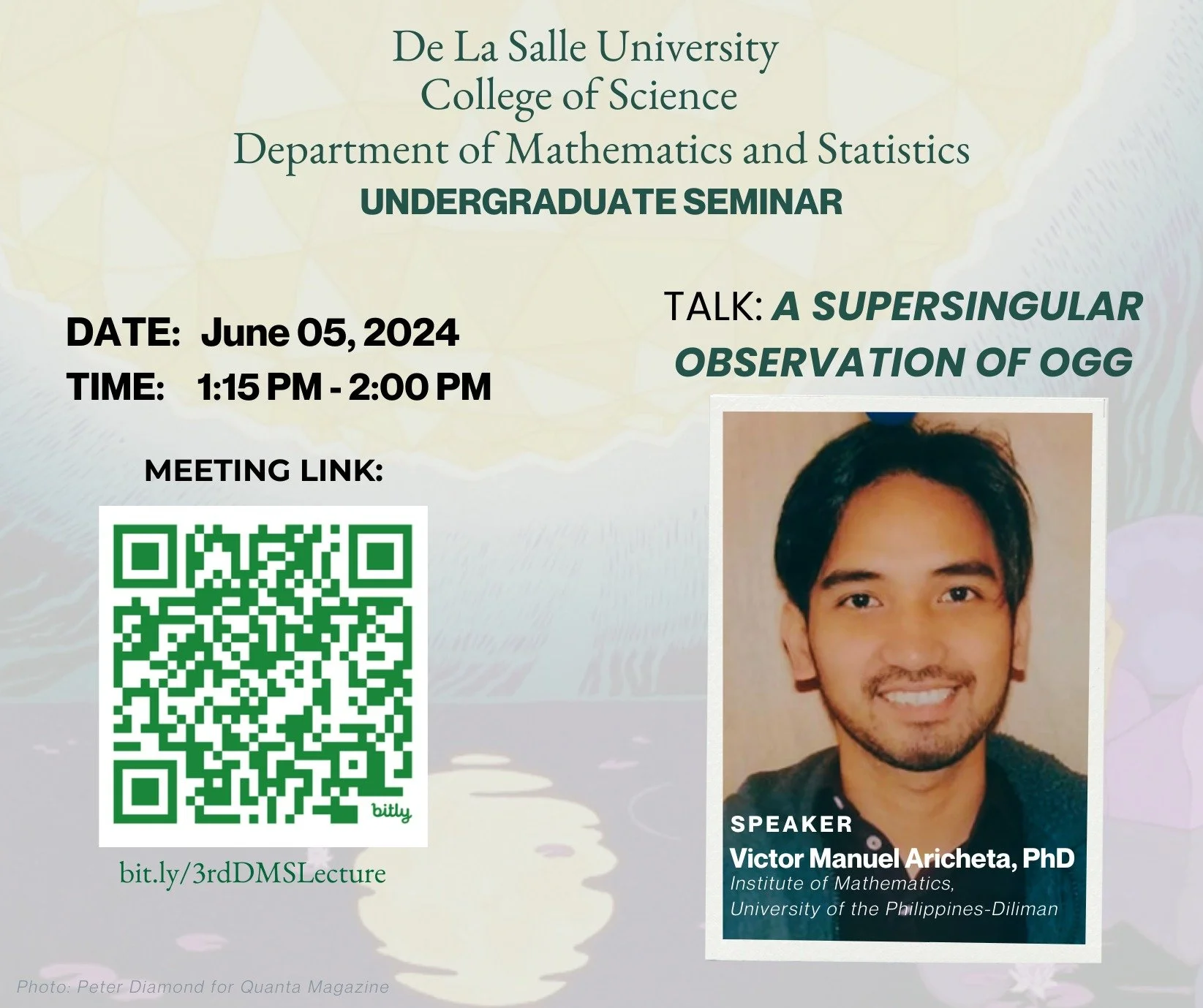
Series 1, Lecture 3
A supersingular observation of Ogg
Dr. Victor Manuel Aricheta
Institute of Mathematics, University of the Philippines-Diliman, PH
In this talk we revisit an observation made by Andrew Ogg in the 1970s, which connects supersingular elliptic curves to the monster group. We then present generalizations of Ogg’s observation, extending the aforementioned connection to other sporadic groups. Time permitting, we also discuss the way these new observations relate to monstrous and umbral moonshine.
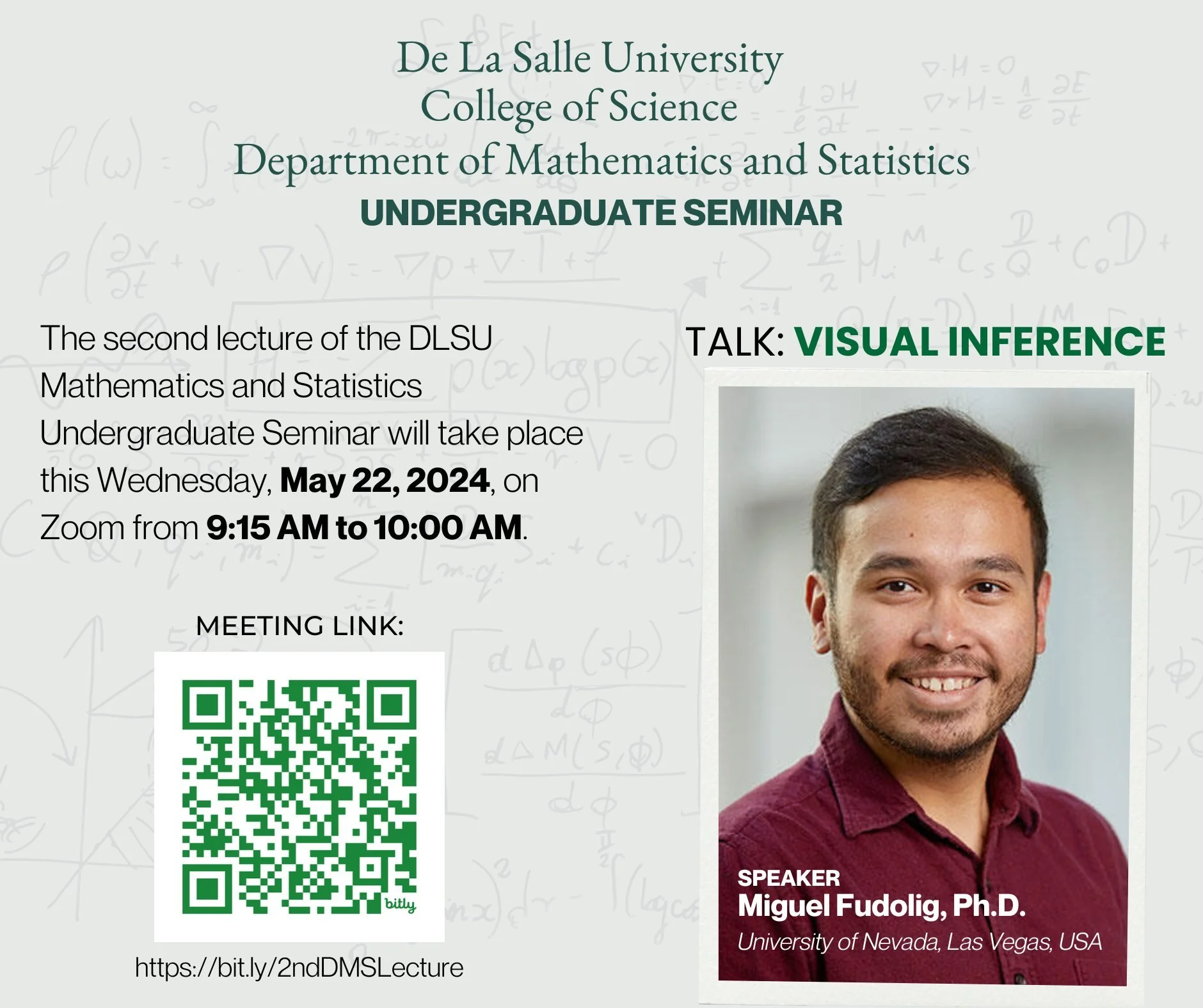
Series 1, Lecture 2
Visual Inference
Dr. Miguel Fudolig
Department of Epidemiology and Biostatistics, University of Nevada, Las Vegas, USA
Detecting change points is crucial in analyzing time series data and single-subject designs. This study investigates factors influencing change point detection through visual perception by employing a visual inference experiment. We focused on four characteristics of a transitional mean shift in the data: the shift magnitude, shift direction, change point location, and overall variance. A total of 210 participants were tasked with identifying the plot with the mean shift among null plots in a lineup panel. We used a factorial experiment with a balanced incomplete block design to assign factor combinations for participants to evaluate. Participants were found to identify higher shift magnitudes more accurately than lower shift magnitudes. Change point data with higher variances had lower identification rates. Direction and change point location effects impacted identifying change point scenarios with lower signal-to-noise ratios. Participants indicated varying reasons for selection across correct and incorrect data plot identifications. Additionally, confidence in selection was positively associated with identification accuracy for change plots with higher signal-to-noise ratios. These insights highlight the complexities of change point detection through visual inference and emphasize the multifaceted nature of human perception in identifying subtle changes within data.
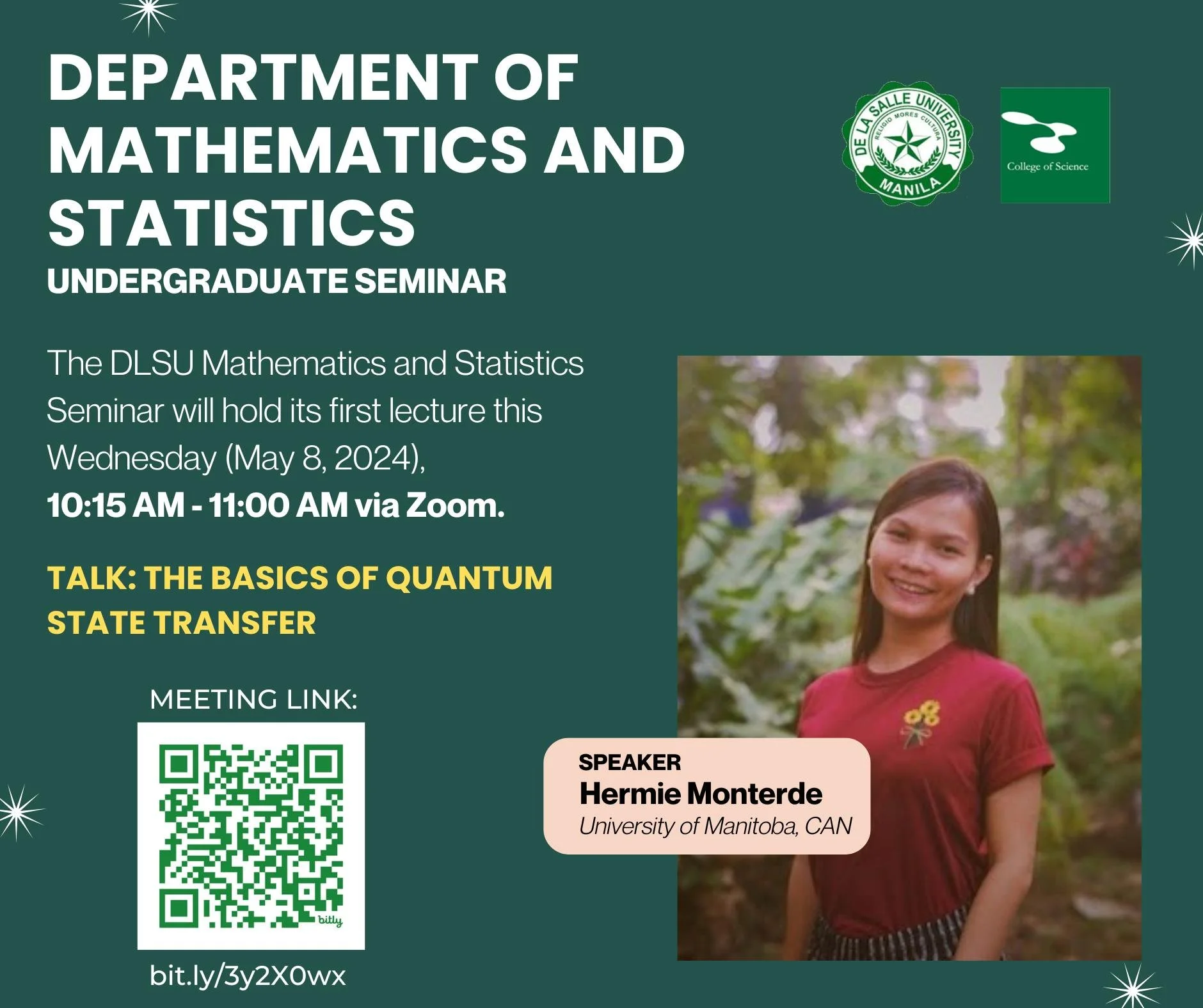
Series 1, Lecture 1
The Basics of Quantum State Transfer
Hermie Monterde
Department of Mathematics, University of Manitoba, CAN
A network of interacting qubits (usually subatomic particles) can be modelled by a connected weighted undirected graph $G$. The vertices and edges of $G$ represent the qubits and their interactions in the network, respectively. Quantum mechanics dictate that the evolution of the quantum system determined by $G$ over time is completely described by the unitary matrix $U(t)=\exp(itA)$, where $A$ is the adjacency matrix of $G$. Here, we interpret the modulus of the $(u,v)$ entry of $U(t)$ as the probability that the quantum state at vertex $u$ is found in $v$ at time $t$. In this talk, we discuss the role of the underlying graphs in the study of quantum state transfer.