DLSU Mathematics and Statistics Seminar
Organizers: R. Arcilla, N. Fortun, and D. Granario
The DLSU Mathematics and Statistics Seminar is an online lecture series launched in Term 3 of AY 2023–2024, featuring three to four sessions each term. The seminar aims to introduce undergraduate students to a broad range of topics in mathematics, statistics, and related disciplines, including expository talks. Speakers range from established researchers to promising undergraduate students, and invitations are extended with a commitment to diversity in research areas, institutional affiliations, gender, and background.

Series 5, Lecture 4
Uniqueness results on the phase retrieval of analytic functions
Dr. Rolando B. Perez III
Institute of Mathematics, University of the Philippines Diliman, PH
The study of phase retrieval involves the recovery of a function $f$ from given data on its magnitude $|f|$. A fundamental question in phase retrieval is the uniqueness of the solution. However, phase retrieval problems typically admit large families of solutions, so additional assumptions on the available data are often required to reduce the solution set or ensure uniqueness.
In this talk, we present results on the unique recovery of analytic functions from their moduli. We first show that unique recovery is possible when the modulus is known on two suitably intersecting line segments. Furthermore, under specific conditions, we establish uniqueness when the modulus is known on two concentric circles.

Series 5, Lecture 3
Introduction to Renormalized Solutions
Dr. Rheadel Fulgencio
Institute of Mathematics, University of the Philippines Diliman, PH
This presentation aims to introduce the audience to the framework of renormalized solutions for second-order elliptic partial differential equations (PDEs), which was introduced by Di Perna and Lions for first-order equations and developed by Lions and Murat for second-order problems.
To this aim, we will discuss the definition of a renormalized solution following Dirichlet boundary problem (1):
\begin{cases} -\operatorname{div}(A(x)\nabla u) + \lambda u = f & \text{ in } \Omega, \\ u=0 & \text{ on } \partial\Omega, \end{cases}
where $\lambda>0$, $\Omega$ is a bounded open set in $R^N$, $N\ge 2$, $f\in L^1(\Omega)$, and $A$ is an elliptic and bounded matrix field. We will then look at the sketch of the proof of the existence and uniqueness of the renormalized solution of (1).

Series 5, Lecture 2
On the distribution of $ v_p(\sigma(n))$
Carlo Francisco E. Adajar
Department of Mathematics, University of Georgia, USA
For a positive integer $ m $ and a prime $ p $, we write $ \sigma(m) := \sum_{d \mid m} d $ for the sum of the divisors of $ m $, and \[v_p(m) := \max\{ k \in \mathbf{Z}_{\ge 0} : p^k \mid m \} \] for the $ p$-adic valuation of $ m $, i.e., the exponent of $ p $ in the prime factorization of $ m $. For each prime $ p $, we give an asymptotic expression for the count \[ \#\{ n \le x : v_p(\sigma(n)) = k \} \] as $ x\to\infty$, uniformly for $ k \ll \log\log{x} $. We then deduce an asymptotic for the count of $ n \le x $ such that $ v_p(\sigma(n)) < v_p(n) $ as $ x \to \infty $. This talk is based on ongoing work with Paul Pollack.

Series 5, Lecture 1
On the trajectory design and optimization of solar sailing spacecraft
Dr. Jeric V. Garrido
Department of Physics, De La Salle University, PH
Department of Mathematics and Physics, University of Santo Tomas, PH
Solar sailing is a space technology which predominantly uses the solar radiation pressure of the Sun for space travel. Due to its limited dependence on chemical propulsion, light sails have potential applications to deep space exploration, generation of non-Keplerian trajectories and formation flybys, or even harnessing materials from celestial bodies. Among the current research problems in this technology is trajectory optimization, which seeks the best path a light sail traverses, while minimizing certain objectives. This talk presents an overview of solar sailing technology, focusing on trajectory design and optimization. We first give a run-down of the historical developments of solar sailing for the past century, leading towards the problem of trajectory optimization. We then compare direct and indirect methods, their advantages and limitations. Finally, we introduce our contribution to this research area, which is designing semi-analytic methods to obtain restricted optimal trajectories, and identify open problems still unanswered in solar sailing.
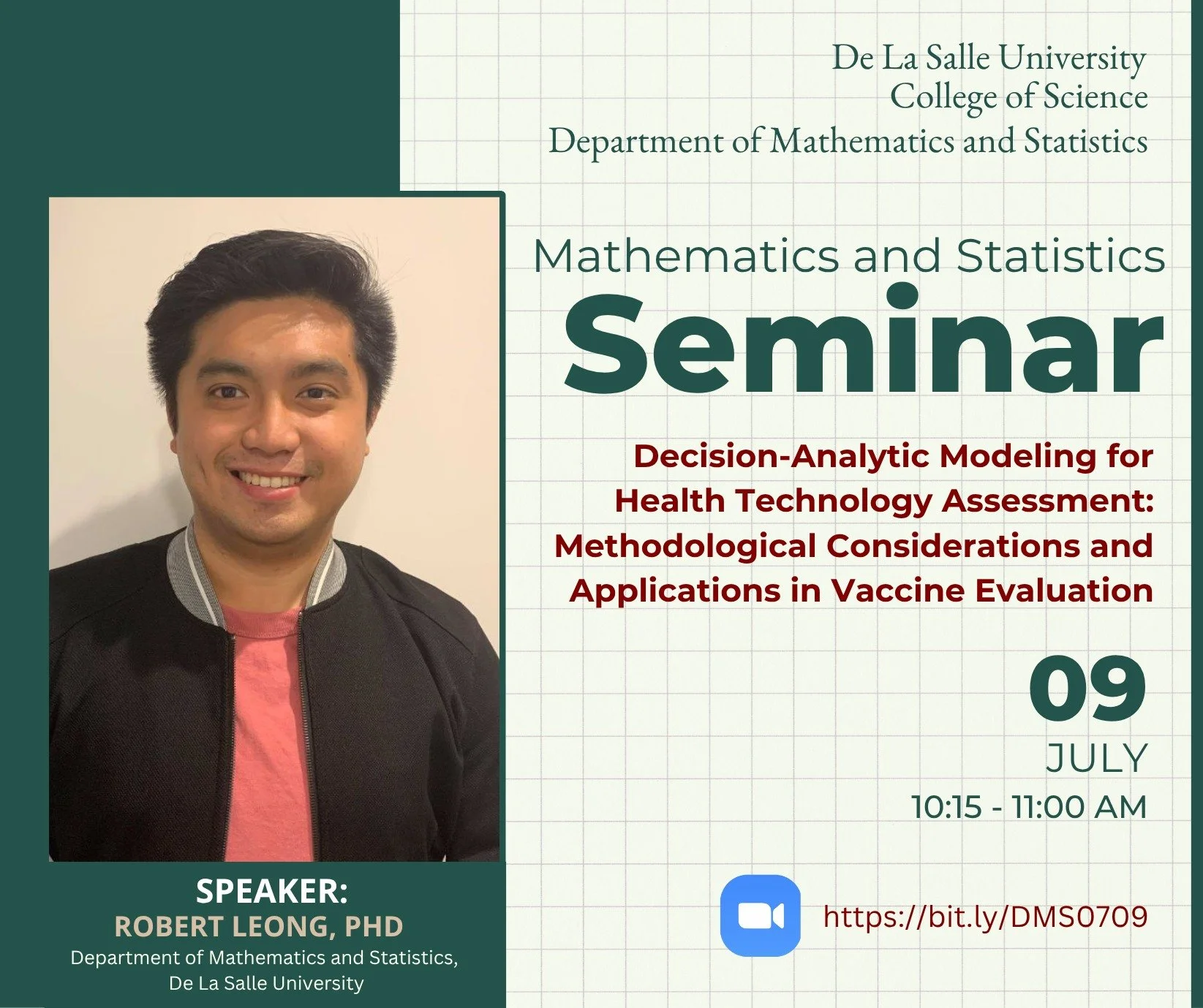
Series 4, Lecture 4
Decision-Analytic Modeling for Health Technology Assessment: Methodological Considerations and Applications in Vaccine Evaluation
Dr. Robert Leong
Department of Mathematics and Statistics, De La Salle University, PH
In the field of Health Technology Assessment (HTA), decision-analytic modeling serves as a important tool for synthesizing evidence and projecting the long-term consequences of healthcare interventions. These models provide a structured framework for evaluating the costs and benefits of new technologies, informing resource allocation decisions in a landscape of uncertainty. Common modeling approaches include decision trees, which map out sequences of events, and Markov models, which simulate disease progression and transitions between health states over time. To account for uncertainty in model inputs, sensitivity analyses are employed, with probabilistic methods offering a comprehensive view of the potential range of outcomes. The economic evaluation of vaccines, however, presents a unique set of challenges that often are not fully captured by standard evaluation methods. Unlike many other medical interventions, vaccines create broad societal value beyond direct health gains, such as herd immunity and reduced transmission of antimicrobial resistance. Standard cost-utility analyses, which often adopt a limited healthcare-sector perspective, can fail to account for these wider benefits, potentially undervaluing vaccination programs. The significant time lag between vaccination and its full health impact, coupled with the difficulty of quantifying benefits like peace of mind, further complicates their economic assessment. These complexities have led to calls for broader analytical approaches, such as cost-benefit analysis, to better encapsulate the full value of vaccines. To illustrate a practical application of these principles in a real-world setting, a post-implementation economic evaluation of the rotavirus vaccination program in the United States was conducted. This study utilized an age-specific, multi-cohort model to compare the actual outcomes of the vaccination program against a "no program" scenario, using epidemiological and healthcare utilization data from 2001 to 2015. The evaluation considered both the healthcare system and societal perspectives. The findings were compelling: after the program's uptake stabilized, rotavirus immunization was found to be cost-saving from a societal perspective. Between 2011 and 2015, the program prevented an estimated 136 deaths and 140,000 hospitalizations due to rotavirus. This case study not only demonstrates the substantial real-world impact and economic value of the rotavirus vaccine but also highlights the importance of retrospective evaluations in validating pre-implementation models and informing future public health decisions.

Series 4, Lecture 3
Homogenization and corrector results of elliptic problems with Signorini boundary conditions in perforated domains
Dr. Jake Avila
Institute of Mathematics, University of the Philippines Diliman, PH
This presentation is devoted to the asymptotic behavior and some corrector-type results of an elastic deformation problem with highly oscillating coefficients posed in a domain periodically perforated with holes of four different sizes. On the boundary of the holes, a class of Signorini boundary condition is imposed; while a Dirichlet boundary condition is prescribed on the exterior boundary. For the critical-sized holes, the homogenization process via periodic unfolding method reveals two new terms at the limit, a reference cell average term and a strange term depending on the capacity of the holes and the negative part of the limit function. Meanwhile, the remaining cases provide either a Dirichlet limit problem or some nonnegative spreading effect at the limit.

Series 4, Lecture 2
Pairs of linear maps from the special linear algebra $\mathfrak{sl}_2$
Dr. Aaron Pagaygay
Department of Mathematics and Statistics, De La Salle University, PH
Let $\mathbb{C}$ denote the field of complex numbers. The special linear algebra $\mathfrak{sl}_2$ is a three-dimensional $\mathbb{C}$-Lie algebra which belongs to the well-studied family of Lie algebras known as classical Lie algebras. A finite-dimensional $\mathbb{C}$-vector space $W$ supports an $\mathfrak{sl}_2$-module structure whenever there exist linear maps from $W$ to $W$ associated to the elements of $\mathfrak{sl}_2$ such that the linear maps capture the defining bracket relations of $\mathfrak{sl}_2$. Suppose $V$ is an arbitrary finite-dimensional irreducible $\mathfrak{sl}_2$-module. In this presentation, we show pairs of diagonalizable linear maps on $V$ such that each linear map act on an eigenbasis for the other one in an irreducible tridiagonal fashion.
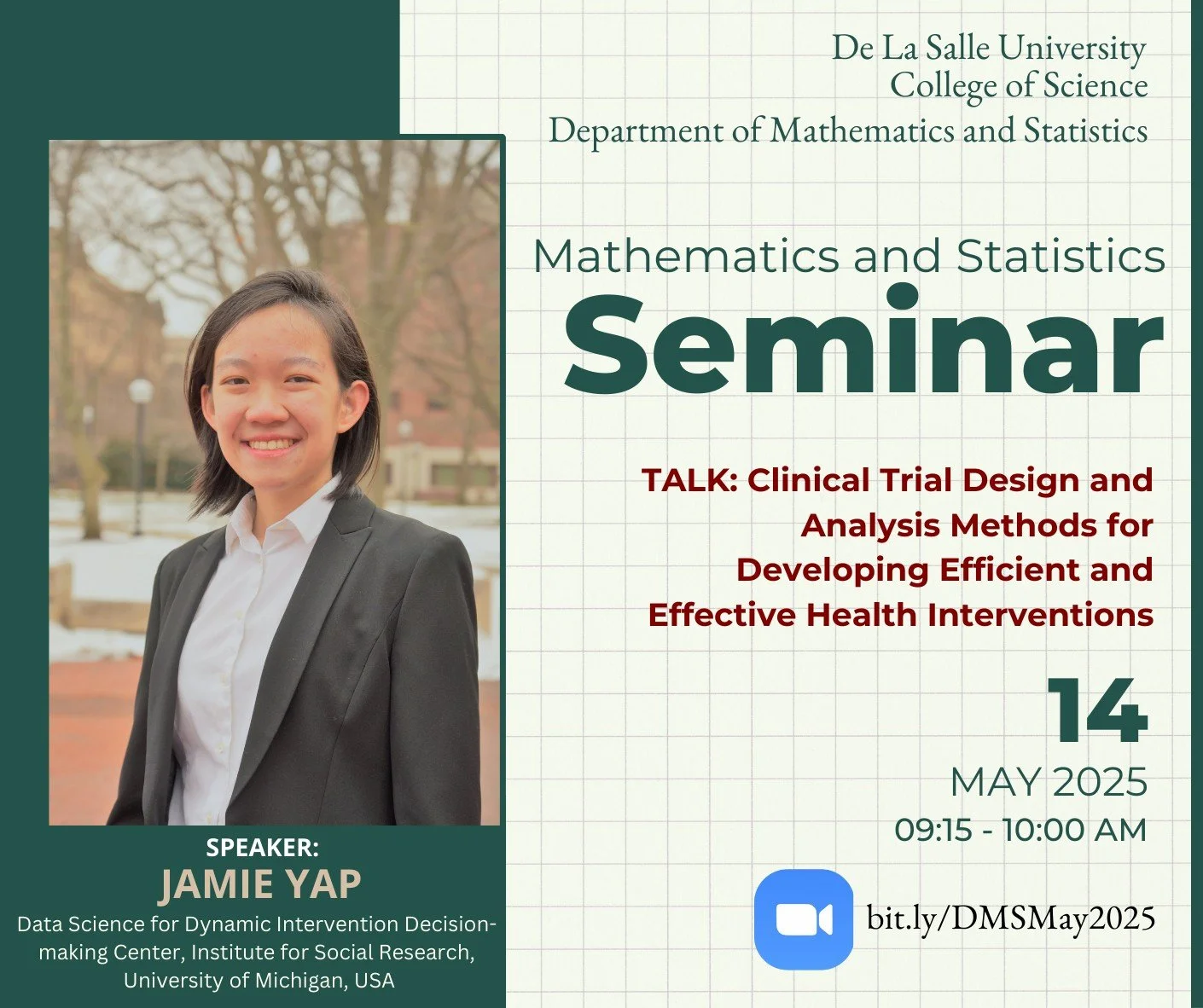
Series 4, Lecture 1
Clinical Trial Design and Analysis Methods for Developing Efficient and Effective Health Interventions
Jamie Yap
Data Science for Dynamic Intervention Decision-making Center, Institute for Social Research, University of Michigan, USA
There is an increased interest in developing treatment protocols that specify the precise time to deliver intervention components. Optimization trials can be used to collect empirical evidence to inform the development of these treatment protocols. However, the common framework for designing optimization trials focuses on planning sample size solely with respect to the primary research question of interest. This framework is inadequate for optimization trials which compare delivery times via sequential randomization, because more than one research question needs to be addressed at the same time, and a plan which maximizes power for one research question may reduce sample size available for other research questions.
We propose a novel framework for designing optimization trials to allow adequate sample size for more than one research question. This paradigm allows investigators to prospectively specify trade-offs about type-1 error rate and power across several research questions during the study design phase.
We illustrate the utility of this framework in the development of a hypothetical weight loss intervention program in adults with obesity.
Broad adoption of our proposed framework can improve the alignment of the process of planning optimization trials with the Resource Management Principle, which states that an “investigator needs to consider how to best use the available resources to inform decision making” about optimizing the candidate intervention components and component options will constitute the treatment protocol that will be subsequently evaluated against a suitable control.

Series 3, Lecture 1
Inverse and ill-posed problems everywhere
Dr. Rommel Real
Department of Mathematics, Physics, and Computer Science, University of the Philippines Mindanao, PH
Inverse problems appear across sciences, from geology to medicine. They aim to solve the parameters given an observed or desired effect. These problems lead to ill-posed problems, which poses challenges in solving them. We present some important examples of inverse problems. Also, we briefly discuss how to solve them when in most instances, exact data are not available, instead only noisy data are available.